Showing posts with label bread. Show all posts

01 January 2025

As I mean to go on.

Yes, same title as last year's, but that's what setting intentions and resolutions are all about, yes?  Or as a friend put it, "as you start so you will go on".

So today involved:

  • Baking bread
  • A yoga class
  • A long walk
  • Reading
  • Drinking Diet Dr. Pepper®
  • Crocheting (a charity item, probably no surprise to anybody)
  • Knitting (somebody suggested starting a new project with the new year, so I did)
  • Chatting and emailing with friends
  • Watching videos by some of my favourite YouTubers
  • Eating homebaked cookies
  • And ice-cream
I also took a nap.

I know many people are feeling this way as the year begins:

Sandra Boynton posted this a few days ago.

Resolutions - Or Goals

Reading:  I set my goal as 18 books to read in 2025, and have a good start because I read three this morning.  Goodreads wouldn't let me count Making Space again (I thought it is wise to start with some guidance for the new year) and then I 'read' two cartoon anthologies:


I'm not really sure that counts as 'reading' but they have words and are officially my first two books of 2025.  I am back to the proper books next.  Additional Goal:  Finish at least two (and ideally all five - I found another one!) of the partly-read books, and finish the other two of the Annette Funicello books.  And I may try to complete this challenge:

Several of these are on my "always" list, so it may
be easy to get about halfway through the challenge.

It's possible some books will count in more than one category.  At least two of the unfinished books qualify, one as #2 (plus possibly #11) and one as #9, and nothing says I have to read the whole book in the year.  My believe is that finishing will count.

Cooking:  I will try to remember to document cooking from historical sources, and to do so at least six months of the year.  Maybe all twelve, if I get inspired.  I will definitely keep cooking; I made hoppin' john to eat today, and had it for breakfast.  And I want to try one new-to-me technique or category of food, so I might have to take a cooking class.

Knitting/Crocheting/Crafting:  I have several goals for this year, most of which are versions of ones from previous years:

  • Finish at least two UFOs, and try to keep the Advent Office Shawl from becoming a UFO.  Up to Day 14 and it appears the shawl will be big enough after Day 25, so I am considering what to do for the "Hannukah Advent" part.
  • Make at least three items for me, not counting the Advent Office Shawl, preferably at least one cardigan.
    • To answer the above two items, I pulled out the 2023 Channukah set I received from Olive and Two Ewes and finally decided on a pattern (not the one I thought of originally for the set), wound yarn and cast on.
    • I also looked at shawl patterns for a Paris colourways set I purchased with the goal of having a shawl made before I go there at the beginning of May.  I have a couple additional shawl patterns in mind for my on-trip project.
    • I think I have settled on a cardigan pattern for some of the Knitting Buddha yarn I have, if it's the correct weight.  I may adjust if it is not.
  • Finish at least one blanket for Warm Up, America!
  • Make at least twenty-five items for charity - a fairly low bar for me, but I don't want to get overambitious because I know where that ends.  Plus one is a blanket.
  • "Dry January" means no yarn shopping!  The items currently in my Etsy basket don't count.  😉
  • I am planning to attend three festivals this year: Carolina Fiber Fest, Maryland Sheep & Wool, and DFW Fiber Fest.  I want to minimize yarn shopping except for those.
  • I want to get my application to enter the North Carolina State Fair competitions in on time!  I missed the deadline for 2024, so three items I had planned to enter are now disqualified as everything has to be made in the year since the last NCSF.  I want to enter at least one item in both the Carolina Fiber Fest and the North Carolina State Fair, the former mostly to get feedback.  I'd planned to enter the item from this year in the State Fair competitions, but oh well!
  • Finish a bunch of the holiday kits I bought and try to sell them in the local arts & crafts group's holiday sale.  I was out of the country this year so didn't participate.
Much more detail for this year's fiber arts resolutions than in pas years!

And in other subjects, I plan to get three rooms repainted (one is mostly touch-up, but it may look better with a full repainting and I am OK with that) and shelves installed in two of them, then get my books and records unpacked, and make progress towards having a working studio and a working media and guest room.  Part of those require hiring people to do the painting and the shelf-building and -installation, and I keep procrastinating.

Stay tuned.

13 February 2023

Again, I spoke.

It was a busy weekend, beginning with the end of a busy week and the Lay-Led service.  On Saturday I had a lot of errands and a theater company board meeting.  Many of the errands involved delivering treats to friends and baked goods to BiCi Co.  I wanted to get rid of some packaged items, so made fancy cupcakes for the holiday:
Clearly my decorating skills need a LOT of practice.

I also tried baking a recipe from a video I watched.  I think the biggest problem is that there isn't enough leavening.  The baker said she did a version off-camera with the "emptins", or liquid yeast, and it didn't do much.  Same as I found when I baked, making a quarter of the recipt:
   
Before baking on the left, after (the bottom) on the right.  No raisins, just seeds, as the raisins I have are fairly large and I didn't want to chop them.  It was fairly solid, not completely a brick, but tasty.

And of course I baked challah for the service.  Everybody seems to like the snack and this week several took an extra piece for later.  I tried a fancy braid as I did last month, but the dough was not cooperative so I reverted to a very simple three-strand braid, which resulted in a very long loaf:
   

On the left, before baking, with the sample roll.  The roll was done and eaten by the time the loaf came out.  I didn't glaze the loaf this time due to lack of milk and not wanting to deal with a partial egg.

I finished the weekend watching the Super Bowl, with just a few snacks.  Having friends and colleagues supporting both teams, I declared myself for Team Guacamole then forgot to pick up an avocado or any packaged stuff so didn't have the iconic snack.  But I did have another iconic snack, this from Chicago:

I also had a sausage for my main course, during the second half.


A friend offered to lead the services this month and next, as long as I do the drash or d'var Torah - the sermon.  This week it's a tough one because while Yitro is short, it is full of elements including two of the key items in Jewish belief.  Because it was a busy work week, and even my evenings were busy with things, I didn't have the time I wanted to take to think about what to say and I felt my drash was unfinished when I gave it.  There was some revising on the fly, and this is the result:

Yitro is a fairly short parasha but it is full of events.  Moses’ father-in-law, Jethro, brings Moses’ wife and children to him, and they have a reunion, including a big dinner with Aaron and other leaders.  Jethro talks to Moses about creating the court system for settling disputes, distributing the responsibility to others to help judge while keeping the communications from and to G-d for himself.

There are the two main elements of this parasha that people usually focus on: the story of how the people gather at Mt. Sinai, how they prepare for the event, and how they are given the first instructions and the promise to be the chosen people.  For many people, standing at Sinai is the key part of this parasha.  We refer to it frequently in our services and our traditions.  “We were all at Sinai” is something you hear regularly in worship and blessings at events.

The other key point is the giving of the ten rules.  G-d says to Moses, in 19:5, “Now then, if you will obey Me faithfully and keep My convent, you shall be My treasured possession among all the people.”  This is the essential bargain that G-d makes with the Israelites: Follow the rules I give to you, and I will make of you “a kingdom of priests and a holy nation.”  (19:6)  Instead of being slaves and on the lowest rung, as they were a few weeks ago, the Israelites will be the most revered category of persons.

But can all the people really be priests, or is it just Aaron and his Clan?  Or, as suggested in the opening scenes when he speaks of taking G-d’s words to the people and their prayers and questions to G-d, it is just Moses?

When Jethro asked Moses what he is doing, sitting there with people coming to him all day and night, Moses said (18:15-16) “It is because the people come to me to inquire of G-d.  When they have a dispute it comes before me, and I decide between one party and another, and I make known the laws and teachings of G-d.”  While Jethro helps Moses find a way to distribute responsibility for the middle one, by creating a series of courts and sharing the responsibility to make decisions and resolve disputes, for the other two, however, there is no distribution by Moses.  He continues to be the only one who speaks to G-d and who informs the Israelites about G-d’s laws and teachings.

I posit that this changes at Mt. Sinai.  All of the people prepare, not just the priests, and all gather at the foot of the mountain.  The people see the power and majesty of G-d in “the thunder and lightning, the blare of the horn and the mountain smoking.” (20:15)    They are afraid, though, and ask Moses if he will “speak to us, and we will obey; but let not G-d speak to us, lest we die.”  Moses reassures him but the people hang back while he does to explain things to G-d.  The people are afraid of direct communication, and it is as though the noise of the horns and thunder prevent them from hearing G-d.  They continue to need an intermediary – Moses – to communicate.

It is for G-d to change this.  In the last few lines of this parasha, G-d seems to take worship from the hands of Moses and the priests, and hand it to the individuals.  G-d tells Moses to instruct the people how to worship, and specifically says in 20:21 that “in every place where I cause My name to be mentioned I will come to you and bless you.”  This makes it clear that the Israelites can pray anywhere.  They are instructed how to make an altar, and that the altar can be different types.  This means that each of us can enter into a direct relationship with G-d, by making our own offerings.  We no longer have a single source of messages from G-d, or one person who can take our prayers to G-d.  Just as Moses distributed the responsibility to adjudicate disputes to others, here G-d distributed the ability to communicate to the community, to each individual standing there.

In the centuries since, we have come to recognize that we don’t need to meet in a single large group for worship, we can meet in smaller groups.  We can each have our own relationship with G-d.  We have a space for our own prayers, directly to G-d, in our services, and instead of thunder and the bleating of horns we recognize “the still small voice within”.

Just as we believe we each stood at Mt. Sinai to hear the words of G-d, so do we believe that we each may continue to hear those words for ourselves.  We don’t need priests to interpret or intervene: as the men of the tribes began to interpret the laws and settle disputes for themselves, so do we individuals have the power to enact our own contract, our own covenant, to follow the terms offered by G-d.


14 January 2023

What Names Can Mean

Last night was the monthly lay-led service, and once again I was asked to give the d'var Torah.  I also baked a loaf of bread for us to share at the end:

Yeasted pumpkin bread made with roasted butternut squash and a milk glaze.

Trying to come up with something to say, my focus was captured by the title of this week's passage, which is also the way Jews refer to the book of Exodus - by its Hebrew name "Sh'mot", not the Greek word which attached to it much later, as Christians and others translated and adapted the Pentateuch.  This is what I said, with a few changes on the fly that may not be captured here:

We know that parashot are called by their (usually) first word.  This week’s parasha is Sh’mot – the word means “Names”.  It starts by listing the names of Joseph’s brothers who traveled to Egypt.  It gives other names as well, including – as Rabbi Fuchs is fond of listing – those of the many women without whom Moses would not have survived, from Shiprah and Puah, the midwives, to his sister Miriam, his wife Zipporah, and so on.  You can read and hear many d’var Torahs about “The Amazing Women of Exodus” including on the Reform Judaism website and Rabbi Fuchs’ blog.

We know that in the Torah, if somebody has a name, it is because they are important.  There is something significant about that person.  Persons without names are not important for who they are, but for what they do, as when Pharaoh’s daughter saves Moses from the river, or when Pharaoh himself responds to Moses and Aaron by making life harder for the Israelite slaves.

G-d asked Adam to give the animals names, and in other places it is G-d who gives people new names at key points in their lives: Abram becomes Abraham, Sarai becomes Sarah, Jacob becomes Israel.  Sometimes we hear that a name has an especial meaning, as when in this parasha Moses names his son Gershom, “for, he said, ‘I have been a stranger in a foreign land.’” (Exodus 1:22)   And G-d also takes a name in this week’s parasha; at 3:15 we read:

And G-d said further to Moses, “This shall you speak to the Israelites: The Eternal, the God of your ancestors – the God of Abraham, the God of Isaac, and the God of Jacob – has sent me to you:

This shall be My name forever,

This My appellation for all eternity.

The writers of the Torah are not the only persons who focus on names.  William Shakespeare’s famous lines include “A rose by any other name would smell as sweet” from Romeo and Juliet in addition to her lament “wherefor are thou Romeo?”, which modern people think means “where are you?” because she cannot see him under balcony.  However, in the language of Shakespeare’s time Juliet is complaining because his name makes him unsuitable as a lover – if he were not Romeo, and a Montague, her family would approve.

Royalty often take a regnant name, different from the one by which they were previously known.  The House of Windsor had been the House of Saxe-Coburg-Gotha until the first World War made a German name unpopular.  Performers often change their names, either by choice or by requirement; in the registry of actors, if somebody already uses a name the next person has to use something else, which is why there are initials and people known by their middle name.  Truck drivers have handles, and so do people on social media.  Westley became the Dread Pirate Roberts, and later offers the name to Inigo Montoya, whose well-known introduction has become a classic example used and meme’d by thousands.

Names can tell something about you: where you are from, who your parents are, your religion, your culture, what or who was in the news when you were born.  You may have a familynickname, a social nickname, a work name.  Some cultures believe your one true name has so much power that nobody can know what it is, and people use different names in different situations which conceal it.  Some people change their name as a way of marking a passage: marriage, divorce, professional achievement.  Children going to college often choose a new nickname or other appellation, to memorialize their stepping out of childhood and the family into their adult being.

Some names are evocative; say them and an image, a personality, instantly spring to mind.  Maybe you have an impression of the person and what she or he did in their lives.  Think of Hartford’s Katherine Hepburn and you get an impression of a tall, thin, independent woman, with a certain vocal tone and mannerisms.  Mark Twain – a pseudonym used by Hartford’s Samuel Clemens – may bring up a man in a white suit, or a mischievous boy talking others into painting a fence.

Think also of the Rev. Dr. Martin Luther King Jr., whose birthday we celebrate on Monday, and in whose name a national Day of Service was instituted.  What do you think of when you hear Dr. King’s name?  Many white people in the places he walked thought and referred to him negatively (I won’t use the words they called him and others in the civil rights movement).  Black people – who were called “Negro” at the time, another example of a name and how it changes over time – thought him a leader, savior, a beacon for persons who sought and fought to overcome discrimination based upon prejudice, much as many of us in this room likely do.  Maybe you think of a loving husband to his wife Coretta – this is the image that inspired a new sculpture on the Boston Common, which shows their hands and arms in an embrace, “a representation of vulnerability and security” according to the executive director of the group that oversaw its creation and installation this week.

When you hear the name of Dr. King, or of Rabbi Abraham Joshua Heschel, whose birthday was earlier this week and who walked beside Dr.King and other Civil Rights leaders in many marches, what do you think?  Do you want to step up to their example and try to change the world?  Do you want to help people in your community?

Rabbi Abraham Joshua Heschel presenting the Judaism and World Peace Award
to Dr. Rev. Martin Luther King Jr., Dec. 7, 1965 (Wikimedia Commons)

Think of the future, when you will be but a name in people’s memories, and remember Iago’s remonstration in Shakespeare’s Othello that “Who steals my purse steals trash / 'tis something, nothing / 'Twas mine, 'tis his, and has been slave to thousands / But he that filches from me my good name / Robs me of that which not enriches him / And makes me poor indeed”.  How will you want them to remember you?  Do you want to be but a type, somebody who took action, nameless otherwise?  Or do you hope that somebody will hear your name, and like the others, a face, a voice, an example spring to mind for others to follow?

Your name can be your legacy.  How will you be remembered?


{NB:  I deleted the information about our community Day of Service on the following Sunday, as that is irrelevant to most of my readers and will be out of date soon after this posts.}

11 December 2022

Patriarchal Preparations.

This Friday brought another lay-led service at my congregation.  This month my co-leader wanted to handle the service so I did the d'var Torah, a short interpretation of or perspective on the parasha (Biblical passage) of the week.  In the Jewish tradition we read through the Torah, or Pentateuch, every year, with a specific passage every week.  So as you can imagine, it can be difficult to find something new to say.

I read what had been said in the past, and some current commentaries.  In the opening, I mentioned a number of these, but deleted those paragraphs here, and am providing just the final result, which really resonated for me - probably why it became my focus:

Parasha Vayishlach offers many options for somebody wishing to discuss its lessons.  We are most familiar with the story of Jacob meeting Esau after many years apart:  How Jacob and his household wait at the side of the river; how he goes off by himself and has a vision, then wrestles with an angel, who gives him a new name – and how we know the supposed man is a messenger of G-d because only G-d gives names; then the reconciliation and parting of the brothers.

I originally decided take inspiration from the beginning of 32:25: “Now Jacob was left alone”.  Then I noticed that 32:8 says that the previous night “Jacob was terrified.”  But look at what he does next.

Jacob doesn’t fall on his face in prayer.  He doesn’t bewail the situation.  We don’t read of him speaking to his family, or taking council with his wives and household leaders.  He doesn’t send for help.  Instead, Jacob takes action.

 He prepares.  He plans.  He isn’t frozen by his fear, he considers options and implements the one that he thinks has the best chance of success.  Yes, he does pray – but only after he separates his household into two camps.  Only after he prepares for what could happen when his brother arrives.  Instead of asking for inspiration, he asks to be saved from what could happen, and reminds G-d that he is following G-d’s requests, that he has apparently been favored by G-d, and that he hopes the preparations will be successful.

G-d does not answer.  Jacob does not get instructions the way Noah did (to build an ark) or that Abram gets with the Akedah.  And when morning comes, Jacob makes more preparations.  He sends a series of gifts to his brother, and then puts his family and remainder of his household across the river, while he awaits his brother.  Jacob makes all these preparations – and this time, he does not ask G-d for a sign.  Instead, Jacob takes some time to be alone.

Many people have read Jacob’s wrestling as a metaphor, as Jacob makes the final decisions before the reunion with his brother.  Whether real or imagined, the key to me is that Jacob is alone, without anybody to help him, or with whom he can discuss his decisions.  He has no sounding board, for even in the description of the wrestling, there is no record of any communication.  They only converse when the angel has to leave, at dawn.  And then Jacob walks back to his family and household, limping and alone.

As he does so, Jacob sees Esau approaching, and he makes one final preparation, to organize his family and household, before his brother arrives.  He still doesn’t know whether Esau will welcome him or fight, but Jacob has considered and prepared for all possibilities.  Again, we see that Jacob doesn’t pray for instructions.  It is, in many ways, like the final shuffling of pages or check of a slideshow presentation before ascending a podium or going onstage.  Many of us have the times when we have prepared all we can, and we don’t know until the event begins whether it is enough.

I take all of this as a recommendation that when you are faced with a daunting situation, especially one that terrifies you, you should tamp down the fear; prepare as much as possible; then take a few minutes to calm yourself before stepping into the unknown.  When you do, may the result be as positive as the one that Jacob received, in Chapter 33:4, when “Esau … ran to meet him, and embraced him, and fell on his neck and kissed him.  And [the brothers] burst into tears.”

Jacob Sees Esau Coming to Meet Him
James Jacques Joseph Tissot, circa 1896-1902
The Collection of the Jewish Museum


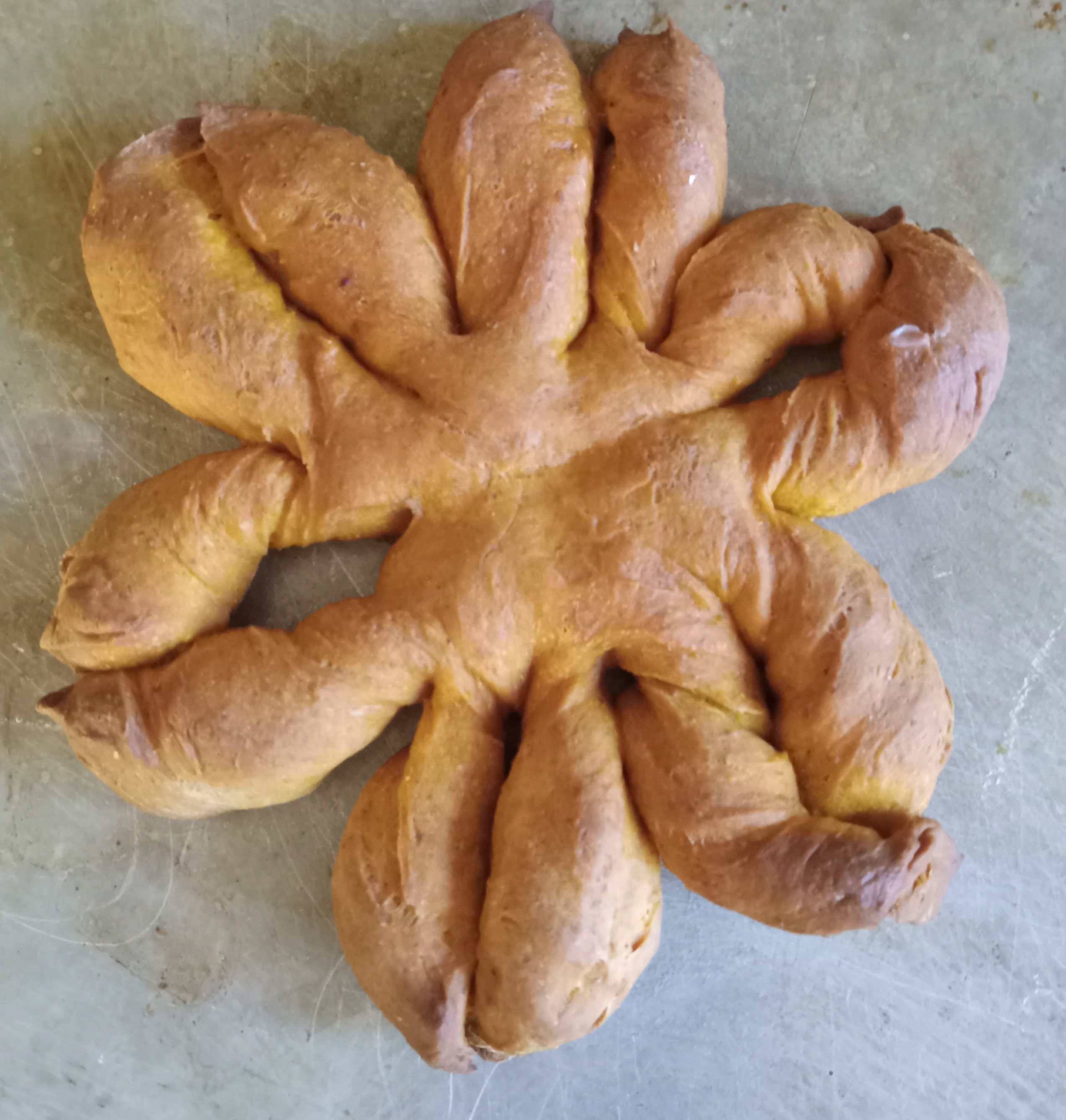
It wasn't clear until Friday afternoon whether my co-leader had arranged for challah, so since I was baking bread I made a mini-loaf to take if needed.  She advised that she made challah to bring, so I have mine, but it came out fairly well for a first attempt at this design:

Unbaked on the left; baked on the right.


The majority of the dough went into a regular loaf for slicing:
Dough in two simple twists.  I did the previous loaf in eight
balls set in two rows of four and wanted to try something different.

Twists side-by-side in the pan, ready to rise.  I wasn't trying
for a fake braid, but they worked out this way.

Baked loaf.

22 September 2020

A Tzaddik

 A bit later than my usual mid-month.  Work has been busy, and I was going to write a post over the weekend, and then came word that Justice Ruth Bader Ginsburg had died on Friday, and everything else seemed unimportant as we Jews faced the double obligation to celebrate Rosh Hashonnah, our new year, while mourning a wise leader.  It is said that those who die just as Rosh Hashonnah begins are a "tzaddik", an especially righteous person, as their death is delayed as long as possible so they can continue to do good in the world.  Certainly with all the illnesses she overcame, it seems that RBG is one of those.

Memorials have been many, from friends and people she influenced and her colleagues.  The son of one spoke eloquently about the friendship his father, the late Antonin Scalia, had with Justice Ginsburg - one of shared interest in opera and the law, that allowed them to be friends outside the chamber even though they usually disagreed within it.  I especially like what Retired Justice Anthony M. Kennedy said, which could be guideposts for all of us to follow as a way to honor her:

By her learning she taught devotion to the law. By her dignity she taught respect for others and her love for America. By her reverence for the Constitution, she taught us to preserve it to secure our freedom.